Personally Speaking: Ruby’s story
By Lisa Dailey
My grandmother Daphne Thompson died on New Year’s Day of 2001, less than a year after my younger sister was
diagnosed with schizoaffective disorder at the age of 20. During my uncle’s eulogy for her, he spoke of the hardship of her youth during the Great Depression and her grief at 10 years old when her mother died.
A few days after the service, my father’s cousin approached him and revealed a secret my grandmother had hidden from us for decades: Daphne’s mother, Ruby, had not died in 1930. She was admitted to a psychiatric hospital and remained institutionalized for the remainder of her life. She died in 1976, a mere 40 miles from where Daphne raised her family.
We were shocked by this revelation. It sounded like a plot twist in a novel. My father struggled with the horror that his grandmother had been a 30-minute drive from him for 40 years and yet had died alone and anonymously. There is no grave. He was also overcome with anger that his mother had stayed silent about Ruby when my sister began to experience symptoms of psychosis in her late teens. My parents had even asked if there was a family history. Would we have recognized what was happening earlier if we had known?
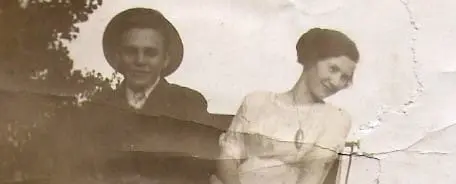
We were able to find out only a few things about Ruby Cornelius Riner. Ruby was born on April 9, 1895 in Illinois. One of a small number of college-educated women in those days, she taught in the Indiana school system until her marriage in 1919. A photo of her on her wedding day shows a smiling young woman who physically resembled the daughter who would go on to deny her existence for most of her life.
There is no record of what caused Ruby to be institutionalized. There is likewise very little information about what her life was like after she was abandoned at the institution. We did learn from a relative that she consistently refused medication and went in and out of psychosis until her death in 1976.
I have often wondered what might have happened to Ruby if she had lived long enough to experience the wave of hospital closures that would
follow her death. Where would she have gone if she had had to leave the institutional home she had always known?
Thorazine, the drug that enabled many people in institutions to return to lucidity, was not available until Ruby had lived without meaningful treatment for more than 20 years. Clozapine, the drug that turned things around for my sister, was not available until 14 years after Ruby died.
Science failed her, and so did the law.
Treatment standards that did not require anyone to try to break through her psychosis left her warehoused in a state hospital for nearly 50 years.
If Ruby could have received treatment, she might never have been institutionalized. The fault for this I lay at the feet of science for not having gotten where it needed to go soon enough to help her. But once drugs were available, nothing changed for Ruby because she refused medication and the law did not require anyone to consider whether her choice was really a choice.
That I lay at the feet of the law – and that I can do something about. Not for Ruby, but for people like her who can and deserve to benefit from treatment.
Before coming to work at Treatment Advocacy Center, I knew I would need to speak with my sister about the work I would be doing. In the past twenty years, involuntary treatment has been necessary at times for her. My work at TAC would have me out in the public as a strong proponent of civil commitment laws, striving for them to be made better. I wanted to know how she would feel about it if I spoke out in favor of making those laws more usable.
What she said amazed me. She told me that she wished the county had been more aggressive with involuntary care right at the beginning of her illness, and had kept her in the hospital long enough to find the right medicine when she was still young. She knew that tiptoeing around her wishes had had disastrous consequences. How much time in partial psychosis, haunted by frightening hallucinations, could she have avoided if decisions hadn’t focused on “behavior” rather than medicine?
Ruby was also someone’s sister, daughter, mother and grandmother. Through my work, I try to honor her as a human being who deserved better than what then passed for treatment. I fight to give people the chance to escape her fate by advocating for a focus on continued medical advances for people with severe mental illness, and compassionate treatment laws that give the benefit of them to our loved ones.
Lisa Dailey is the executive director of advocacy at Treatment Advocacy Center.