RESEARCH WEEKLY: Top federal research agency investigates types of crimes committed by individuals with serious mental illness in US prisons
(Apr. 4, 2018) The top federal research agency, the United States Government Accountability Office (GAO), finds that individuals with serious mental illness who are incarcerated in federal prisons are disproportionately represented in criminal convictions that differ from those of the general inmate population. Below are several of these disparities:
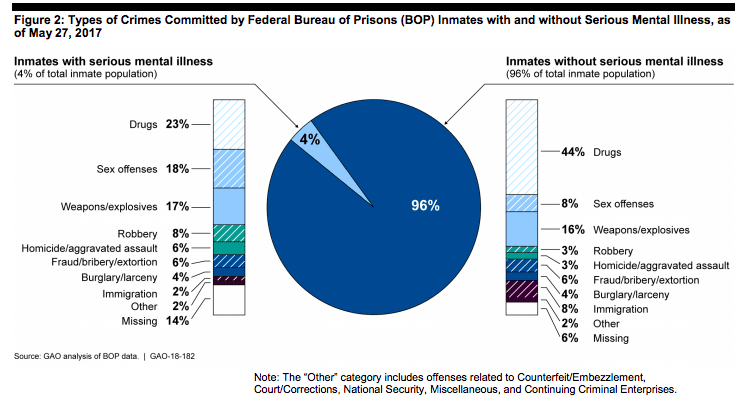
- Approximately one quarter of individuals with serious mental illness are incarcerated in federal prisons due to a drug crime, while almost one half of individuals without serious mental illness are behind bars for such crimes.
- Conversely, 18% of individuals with serious mental illness are behind bars for sex offences compared to 8% of those without a serious mental illness.
- 8% of individuals with serious mental illness are incarcerated in federal prisons due to robbery charges compared to 3% of inmates without serious mental illness.
- Individuals with serious mental illness are incarcerated in federal prisons for homicide or aggravated assault at a rate that is twice that of individuals without serious mental illness.
The GAO investigation comes as a result of the 21st Century Cures Act, signed into law by former President Obama in December 2016. The law directed the GAO to determine the types of crimes committed by individuals with serious mental illness who are behind bars and the costs associated with treating these individuals. A 65-page report to Congress, the culmination of the investigation, was released in February on the agency’s website.
A deeper dive into the investigation findings
The Bureau of Prisons (BOP) is required to provide adequate medical care, including mental health care, to individuals under its supervision. All individuals who are designated to a BOP prison are screened for mental health needs and given a mental health designation code that stays with them throughout their sentence.
According to the GAO report, BOP estimates 4.2% of individuals in federal prison have a serious mental illness. There are a number of reasons that this number could be significantly lower than the 2017 Bureau of Justice Statistics estimation that 14% of individuals in prison experience symptoms of serious mental illness on any given day. For example, individuals in federal prison make up less than 10% of the whole pie of incarcerated individuals in the United States, and the proportion of individuals with serious mental illness who are convicted of federal crimes is much smaller than those who commit lesser crimes and wind up in local jails or state prisons.
Alternatively, because BOP needs to account for any individual that is classified as having a serious mental illness for the entirety of their sentence, 4.2% may be a significant underestimation. The definition of serious mental illness that BOP utilizes is based on an individual’s function and illness history, informed by psychiatric diagnosis but not driven by it. The report offers analysis of BOP data but does not speculate as to why this figure is significantly smaller than other federal estimates, or why people with mental illness are overrepresented in some criminal convictions but underrepresented in others. No matter the definition, this still represents, at a bare minimum, 7,831 individuals who are seriously mentally ill in federal prisons.
The costs of providing psychiatric care to these individuals, despite being mandated by the 21st Century Cures Act, will be difficult to ascertain. According to the report, “the agency does not track costs specifically associated with inmates with serious mental illness due to resource restrictions and the administrative burden such tracking would require.”
As we wrote in our 2017 report, A Crisis in Search of Data, “researchers and government agencies must collaborate to develop a common definition of serious mental illness for use in data collection.” Until the data exists to track the economic impact of serious mental illness in different public service systems, the issues, and the individuals with serious mental illness who are impacted, will remain overlooked.