My daughter is not dangerous enough to get the help she needs
By a mother in Pennsylvania

“HIPAA handcuffs” have ensured that my adult daughter, who has Bipolar 1, is surviving, but never thriving. Without input from the person who knows their child best, and who is invested in their success and wellbeing unconditionally, our children with severe mental illness (SMI) will never live to their fullest potential.
My daughter had a medically challenging start to life and faced behavioral issues by her early teenage years, which, in retrospect, were likely early manifestations of Bipolar. Despite my efforts at early intervention through therapy and enlisting a social worker for an evaluation, my concerns were dismissed, and I was told that I was the problem – a “helicopter parent,” a phrase that is likely familiar to many parents of children with SMI.
My daughter was ultimately officially diagnosed with Bipolar 1 as a young adult, after an episode of psychosis during which she imagined her other parent was following her, and that I was trying to poison her. I was able to intervene in the only way I had available to me at the time – through Pennsylvania’s “302,” which refers to an involuntary 120-hour hold for evaluation. I broke down and cried when the psychiatrist who evaluated my daughter asked me, “How long has this been going on?” It was the first time my concerns for my daughter were validated rather than dismissed, despite years of trying to get someone to believe me that something wasn’t right.
Unfortunately, this was one of the few times I was included in my daughter’s evaluation or care, despite her diagnosis. Largely, I’ve faced persistent blockades getting information about my daughter’s health, or allowing me to provide medical history or support, due to claims of “HIPAA.” One of the surest ways I know my daughter isn’t well is when I’m locked out of her life, unable to provide her with love and support, or to provide her medical team with important information or be informed of her care status.
This trend has continued, with my daughter having anosognosia (lack of insight) when she is in active psychosis, and her psychosis presenting as fixed false beliefs that I am trying to harm her. Anosognosia makes it impossible for her to consent to my involvement in her care, precisely when she needs it most, and despite my unconditional love and desire for her wellbeing. I am sure this is familiar to many other mothers of adult children with SMI.
When my daughter is not in psychosis, she wants me involved in her life and her care. But her psychosis hasn’t been well-controlled, and due to HIPAA handcuffs, I am not given information about their medication, dosage, living situation, or their other needs.
When I am allowed to advocate and care for my daughter, I am able to push through protective measures like getting her on disability, which gives my daughter a small safety net. But the cycle of psychosis and shutting me out continues, leading to a revolving door of crisis, hospitalization, short-term stabilization, and then back to crisis.
Recently, I reached out to my daughter, trying to ascertain if she was okay. I knew she was not when a couple of days later, I received a threatening email back from her. Deeply concerned that she might harm herself, I reached out to the crisis center and local police. The crisis center was rude to me, and only after I called a second time, did they take the small step of phoning my daughter and asking her if she was okay. No one went to check on her. They called me back and said: your daughter says she’s fine.
Still worried since her behavior suggested she had slipped back into psychosis, I contacted the police and begged them to go check on my daughter in person. The police officer reported back that my daughter again had said she was fine; his hands were tied until and unless she was harming herself or others. Even though her emails to me were threatening, the police officer mentioned that I could be the one arrested if my daughter were to file a PFA (protection from abuse), as she threatened to do if I contacted her again. He wanted to make me aware of this. It was all such a nightmare, and I have never felt more helpless.
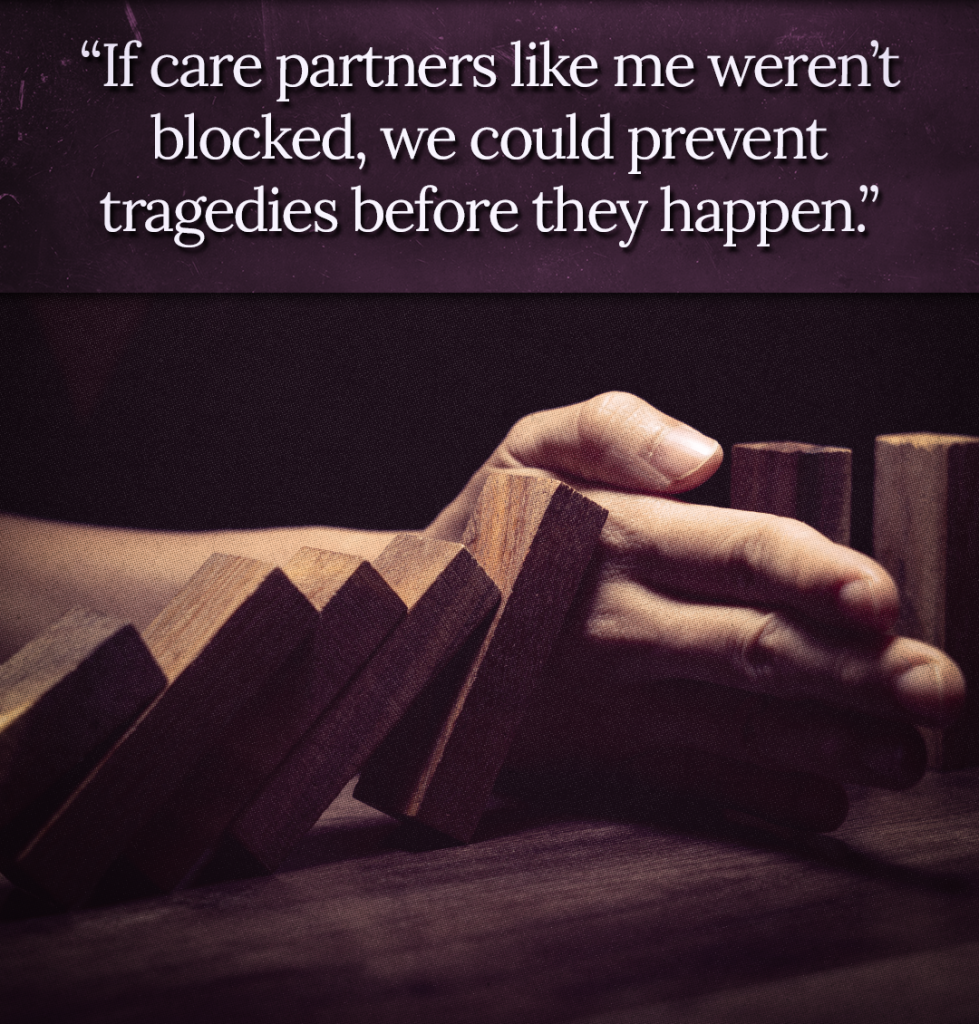
It is a fact that people in psychosis are unable to make rational, informed decisions about who is best positioned to provide care. If care partners like me weren’t blocked at every twist and turn in the mental health care system, we could alert our loved one’s care team when they are acting out of character, let them know which medications and dosages actually help, provide support in navigating complex and increasingly frustrating care systems, and prevent tragedies before they happen.
My daughter is bright, talented, and when medicated and stable, she is a force for good in this world. As a parent, all I want is to see her live a healthy and happy life. The intersection of my daughter’s illness with HIPAA handcuffs means that my daughter cannot escape the revolving door of SMI. I want a better life for her, and for everyone living with SMI.