Grading the States: An Analysis of U.S. Psychiatric Treatment Laws
Instead of being a single, unified system, mental health in the U.S. is a patchwork of legal frameworks shaped by state laws, policies, and priorities. Each state defines for itself when and how a person with serious mental illness (SMI) can receive involuntary psychiatric treatment. As a result, whether someone experiencing psychosis receives timely, appropriate medical care or instead deteriorates toward crisis often depends more on geography than on clinical need.
Treatment Advocacy Center (TAC) is dedicated to eliminating barriers to treatment for people experiencing SMI with psychosis. Central to this mission is reforming state involuntary treatment laws that form the legal foundation — and often the only non-carceral pathway — for accessible care to serve individuals with the most severe symptoms. When these laws are designed well and used appropriately, they enable early interventions to prevent homelessness, repeat hospitalizations, criminalization, long-term disability, and avoidable harm to individuals, families, and communities.
Grading the States: An Analysis of U.S. Psychiatric Treatment Laws analyzes and compares the civil commitment laws of all 50 states and the District of Columbia. Using a rigorously defined and consistently applied grading framework, TAC evaluated whether each state’s laws permit evaluation and treatment in a timely manner, for sufficient duration, and in ways that support stabilization and long-term well-being.
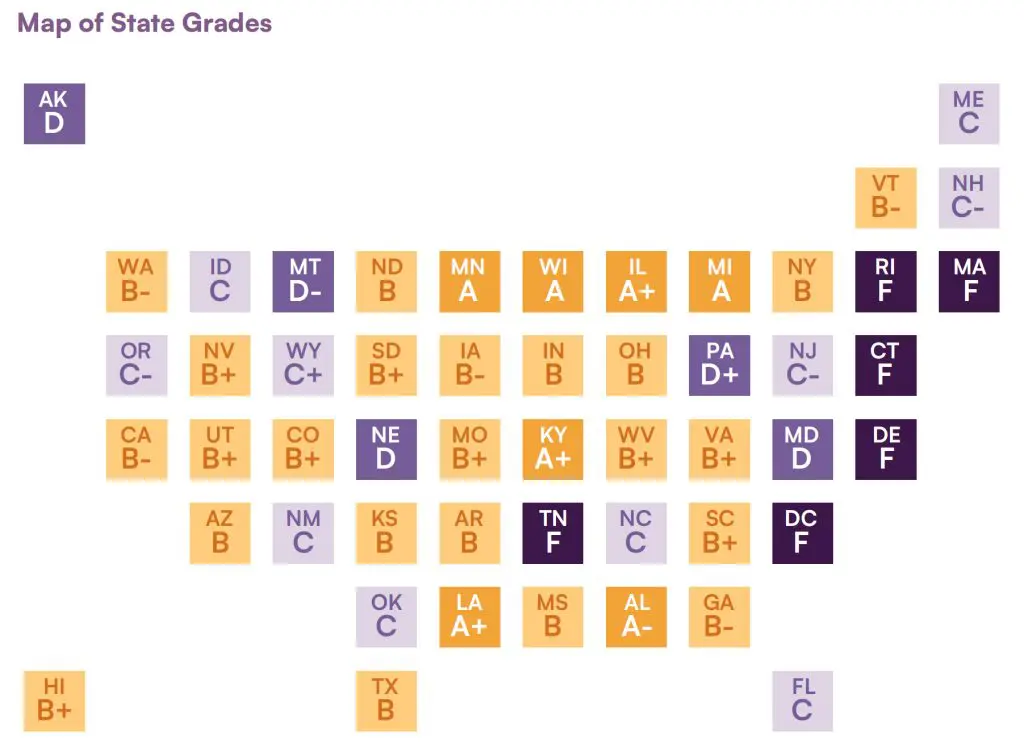
TAC’s report assesses how well a state law allows or impedes access to care, on paper — not how well a state implements or funds their systems. The findings reveal substantial variation across the country, including that:
- A small number of states have statutory frameworks that support a full continuum of care, from emergency evaluation through inpatient treatment and assisted outpatient treatment (AOT).
- Other states maintain laws that impose unnecessarily high thresholds, procedural barriers, or outdated standards that delay intervention until illness escalates to crisis or criminal legal involvement.
- While many states have made incremental reforms in recent years, particularly related to outpatient commitment, many civil commitment statutes still reflect legal standards developed during the deinstitutionalization era. These outdated laws are poorly aligned with modern clinical understanding of psychosis, anosognosia, and treatment nonadherence.
Barriers at any point in the treatment continuum can fully block access to care. Short emergency holds can result in premature discharge without stabilization. Restrictive inpatient criteria can prevent severely ill individuals from qualifying for care. Weak or impractical outpatient laws can undermine continuity of treatment after discharge. Even strong laws in one area cannot compensate for deficiencies in another.
Modernizing involuntary treatment laws is an essential and immediately available policy lever for improving access to care for people with SMI. While legal reform alone cannot resolve gaps in funding or capacity, it establishes the foundation for earlier intervention, reduced criminalization of mental illness, and better long-term outcomes for individuals, families, and communities.
TAC’s recommendations for improving state statutes include:
- Specify psychiatric deterioration (declining mental health and functioning) and grave disability (inability to care for oneself) within criteria for dangerousness to self.
- Remove requirements that harm must be imminent (happening in the moment) or unreasonably severe.
- Permit responsible adults, or at a minimum guardians and family members, to directly petition the court for involuntary services.
- Describe civil commitment procedures and criteria in sufficient detail so that any responder is equipped to utilize the law with accountability for both person-centered care and the protection of due process rights.
To learn more about your state’s grade and recommendations for improvement, click the link below to enter your email and download the full report.