South Carolina Severe Mental Illness Resources & Helpful Info
The term severe mental illness (SMI) includes schizophrenia spectrum disorders, severe bipolar disorder, and major depression with psychotic features. These disorders put an individual at high risk for criminalization and preventable tragedies such as victimization and suicide. Every state has different laws and policies around accessing treatment for SMI and some states have more resources and treatment options than others. Here you will find state-specific resources for navigating the SMI treatment system, an evaluation of local laws, as well as state SMI data and research.
- South Carolina Department of Mental Health (scdmh.net) Resources and contacts
- South Carolina Department of Alcohol and Other Drug Abuse Services (sc.gov) (daodas.sc.gov) Addiction resources
- United Way South Carolina 2-1-1 (sc211.org) Search for services by zip code, city, county
- NAMI South Carolina (namisc.org) Support groups, training, information
- Disability Rights South Carolina (disabilityrightssc.org) Protection and advocacy for individuals with disabilities
- Homeless Information: South Carolina | U.S. Department of Housing and Urban Development (HUD) (hud.gov/states/south_carolina) Shelter locator and links to local resources
- South Carolina Department of Corrections Incarcerated Inmate Search (public.doc.state.sc.us) Search for someone in prison by SCDC, SID, or name
- South Carolina Bar (scbar.org) Legal assistance
How many people in South Carolina have SMI?
individuals with severe mental illness.
individuals with SMI who receive treatment in a given year.
of the adult population is estimated living with a SMI in the United States.
State psychiatric hospital beds in South Carolina
2023 total beds: 423
- Civil beds: 210
- Forensic beds: 213
2023 beds per 100,000 people: 8
Click here for more information about state psychiatric hospital beds in South Carolina.
A minimum of 50 beds per 100,000 people is considered necessary to provide minimally adequate treatment for individuals with severe mental illness. South Carolina fails to meet this minimum standard.
For Additional Information
Data is a powerful tool to advocate for change. Curious about a specific data point in your state? Reach out to us at ORPA@treatmentadvocacycenter.org
Fast Facts on SMI in South Carolina
Deinstitutionalization, outdated treatment laws, discriminatory Medicaid funding practices, and the prolonged failure by states to fund their mental health systems drive those in need of care into the criminal justice and corrections systems.
19%
5,539
423
13 to 1
2021 South Carolina State Mental Health Agency's expenditures
Every state receives block grant funding from the federal government to provide mental health services to their community. Below is some information about how these dollars are spent and compares to other state spending.
$486,074,456
31%
$5,024
1.6%
South Carolina's Treatment Laws
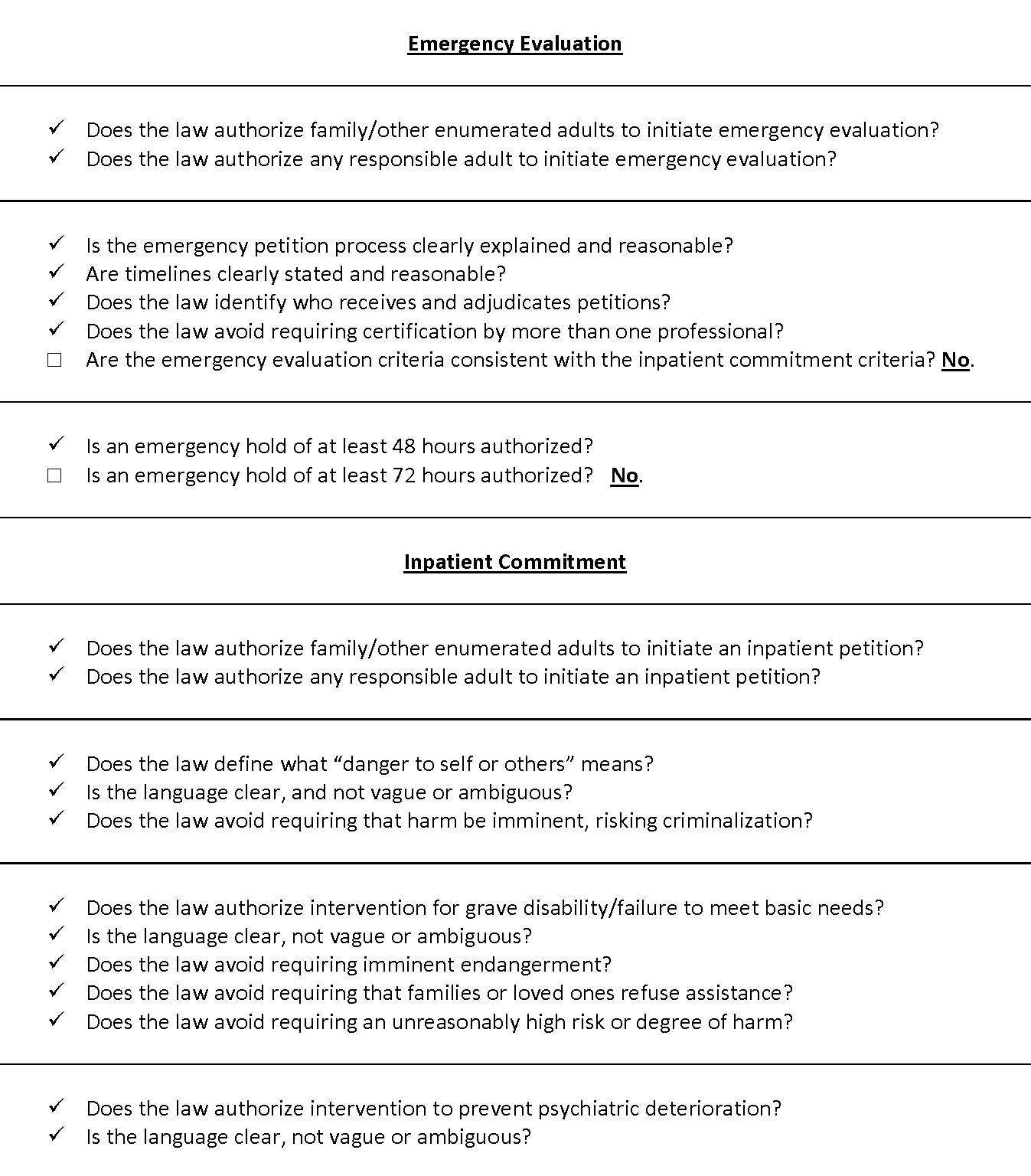
S.C. CODE ANN. § 44-17-410. A person may be admitted to a public or private hospital, mental health clinic, or mental health facility for emergency admission upon: (1) written affidavit under oath by a person stating [the belief that a person meets the criteria]. S.C. CODE ANN. § 44-17-410. A person may be admitted to a public or private hospital, mental health clinic, or mental health facility for emergency admission upon: (1) written affidavit under oath by a person stating: (a) a belief that the person is mentally ill and because of this condition is likely to cause serious harm to himself or others if not immediately hospitalized; (b) the specific type of serious harm thought probable if the person is not immediately hospitalized and the factual basis for this belief; (2) a certification in triplicate by at least one licensed physician stating that the physician has examined the person and is of the opinion that the person is mentally ill and because of this condition is likely to cause harm to himself through neglect, inability to care for himself, or personal injury, or otherwise, or to others if not immediately hospitalized. The certification must contain the grounds for the opinion[.] S.C. CODE ANN. § 44-17-430. If a person believed to be mentally ill and because of this condition likely to cause serious harm if not immediately hospitalized cannot be examined by at least one licensed physician … because the person's whereabouts are unknown or for any other reason, the petitioner seeking commitment … shall execute an affidavit stating a belief that the individual is mentally ill and because of this condition likely to cause serious harm if not hospitalized, the ground for this belief and that the usual procedure for examination cannot be followed and the reason why. Upon presentation of an affidavit, the judge of probate for the county in which the individual is present may issue an order requiring a state or local law enforcement officer to take the individual into custody for a period not exceeding twenty-four hours[.]
S.C. CODE ANN. § 44-17-510. Proceedings for involuntary hospitalization by judicial procedure may be commenced by filing a written petition with the probate court of the county where he is present or where he is a resident by any interested person or the superintendent of any public or private mental institution in which he may be[.] S.C. CODE ANN. § 44-17-580(A). If, upon completion of the hearing and consideration of the record, the court finds upon clear and convincing evidence that the person is mentally ill, needs treatment and because of his condition: (1) lacks sufficient insight or capacity to make responsible decisions with respect to his treatment; or (2) there is a likelihood of serious harm to himself or others, the court shall order in-patient or out-patient treatment at a mental health facility … and may order out- patient treatment following in-patient treatment. S.C. CODE ANN. § 44-23-10(13). "Likelihood of serious harm" means because of mental illness there is: (a) a substantial risk of physical harm to the person himself as manifested by evidence of threats of, or attempts at, suicide or serious bodily harm; (b) a substantial risk of physical harm to other persons as manifested by evidence of homicidal or other violent behavior and serious harm to them; or (c) a very substantial risk of physical impairment or injury to the person himself as manifested by evidence that the person is gravely disabled and that reasonable provision for his protection is not available in the community. S.C. CODE ANN. § 44-23-10(7) “Gravely disabled” means a person who, due to mental illness, lacks sufficient insight or capacity to make responsible decisions with respect to his treatment and because of this condition is likely to cause harm to himself through neglect, inability to care for himself, personal injury, or otherwise. S.C. CODE ANN. § 44-23-10(21). "Person with a mental illness" means a person with a mental disease to such an extent that, for the person’s own welfare or the welfare of others or of the community, the person requires care, treatment or hospitalization.

Recommended updates to treatment laws
- 1
Amend S.C. Code Ann. § 44-17-410 to make emergency evaluation standard consistent with inpatient standard by incorporating other inpatient criteria as bases for emergency evaluation
- 2
Amend S.C. Code Ann. § 44-17-410(3) to extend duration of emergency hold to at least 72 hours
- 3
Amend S.C. Code Ann. §§ 44-17-580 in order to (1) provide procedural detail including responsible parties and (2) add a requirement that a written treatment plan be submitted to the court
- 4
Adopt express procedures for the court to monitor uncontested AOT orders entered into voluntarily to give the benefit of the black robe effect to all enrollees