Alaska Severe Mental Illness Resources & Helpful Info
The term severe mental illness (SMI) includes schizophrenia spectrum disorders, severe bipolar disorder, and major depression with psychotic features. These disorders put an individual at high risk for criminalization and preventable tragedies such as victimization and suicide. Every state has different laws and policies around accessing treatment for SMI and some states have more resources and treatment options than others. Here you will find state-specific resources for navigating the SMI treatment system, an evaluation of local laws, as well as state SMI data and research.

Jump to section:
- Alaska Department of Behavioral Health (health.alaska.gov/dbh) Resources and contacts
- Treatment & Recovery (health.alaska.gov/dbh) Resources specific to addiction and substance use disorder
- Mental Health Facilities in Alaska (mentalhealthcenters.net) Treatment facilities listed by city, county, and tribal affiliation
- Mental Health Resources in Alaska (rtor.org) Nonprofit provides an online form for personalized assistance from a resource specialist
- NAMI Alaska (namialaska.org) Support groups, training, information
- Disability Law Center of Alaska (dlcak.org) Protection and advocacy for individuals with disabilities
- Recovery and housing supports (health.alaska.gov) Housing vouchers and options for supportive housing and employment
- Alaska Inmate Search (inmateid.com/region/alaska) Search for someone in prison
- Alaska Bar Association (alaskabar.org) Legal assistance
How many people in Alaska have SMI?
individuals with severe mental illness.
individuals with SMI who receive treatment in a given year.
of the adult population is estimated living with a SMI in the United States.
State psychiatric hospital beds in Alaska
2023 total beds: 60
- Civil beds: 50
- Forensic beds: 10
2023 beds per 100,000 people: 8.2
Click here for more information about state psychiatric hospital beds in Alaska.
A minimum of 50 beds per 100,000 people is considered necessary to provide minimally adequate treatment for individuals with severe mental illness. Alaska fails to meet this minimum standard.
For Additional Information
Data is a powerful tool to advocate for change. Curious about a specific data point in your state? Reach out to us at ORPA@treatmentadvocacycenter.org
Fast Facts on SMI in Alaska
Deinstitutionalization, outdated treatment laws, discriminatory Medicaid funding practices, and the prolonged failure by states to fund their mental health systems drive those in need of care into the criminal justice and corrections systems.
14%
649
60
11 to 1
2021 Alaska State Mental Health Agency's expenditures
Every state receives block grant funding from the federal government to provide mental health services to their community. Below is some information about how these dollars are spent and compares to other state spending.
$180,662,221
19%
$8,543
1.5%
Alaska's Treatment Laws
ALASKA STAT. § 47.30.700(a). Upon petition of any adult, a judge shall immediately conduct a screening investigation or direct a local mental health professional … to conduct a screening investigation of the person. ALASKA STAT. § 47.30.705(a). A peace officer, a psychiatrist or physician who is licensed to practice in this state or employed by the federal government, or a clinical psychologist licensed by the state Board of Psychologist and Psychological Associate Examiners who has probable cause to believe that a person [meets the criteria for emergency evaluation] may cause the person to be taken into custody and delivered to the nearest crisis stabilization center (…) or the nearest evaluation facility. ALASKA STAT. § 47.30.705(a). [Where there is] probable cause to believe that a person is gravely disabled or is suffering from mental illness and is likely to cause serious harm to self or others of such immediate nature that considerations of safety do not allow initiation of [a court-ordered screening investigation] … the person [may] be taken into custody and delivered to the nearest crisis stabilization center (…) or the nearest evaluation facility.
ALASKA STAT. § 47.30.730(a). The petition [for commitment] must be signed by two mental health professionals who have examined the respondent, one of whom is a physician. ALASKA STAT. § 47.30.735(c). [T]he court may commit the respondent to a treatment facility … if it finds, by clear and convincing evidence, that the respondent is mentally ill and as a result is likely to cause harm to the respondent or others or is gravely disabled. ALASKA STAT. § 47.30.915(15). "likely to cause serious harm" means a person who (A) poses a substantial risk of bodily harm to that person's self, as manifested by recent behavior causing, attempting, or threatening that harm; (B) poses a substantial risk of harm to others as manifested by recent behavior causing, attempting, or threatening harm, and is likely in the near future to cause physical injury, physical abuse, or substantial property damage to another person; or (C) manifests a current intent to carry out plans of serious harm to that person's self or another. ALASKA STAT. § 47.30.915(11). "gravely disabled" means a condition in which a person as a result of mental illness: (A) is in danger of physical harm arising from such complete neglect of basic needs for food, clothing, shelter, or personal safety as to render serious accident, illness, or death highly probable if care by another is not taken; or (B) will, if not treated, suffer or continue to suffer severe and abnormal mental, emotional, or physical distress, and this distress is associated with significant impairment of judgment, reason, or behavior causing a substantial deterioration of the person's previous ability to function independently.
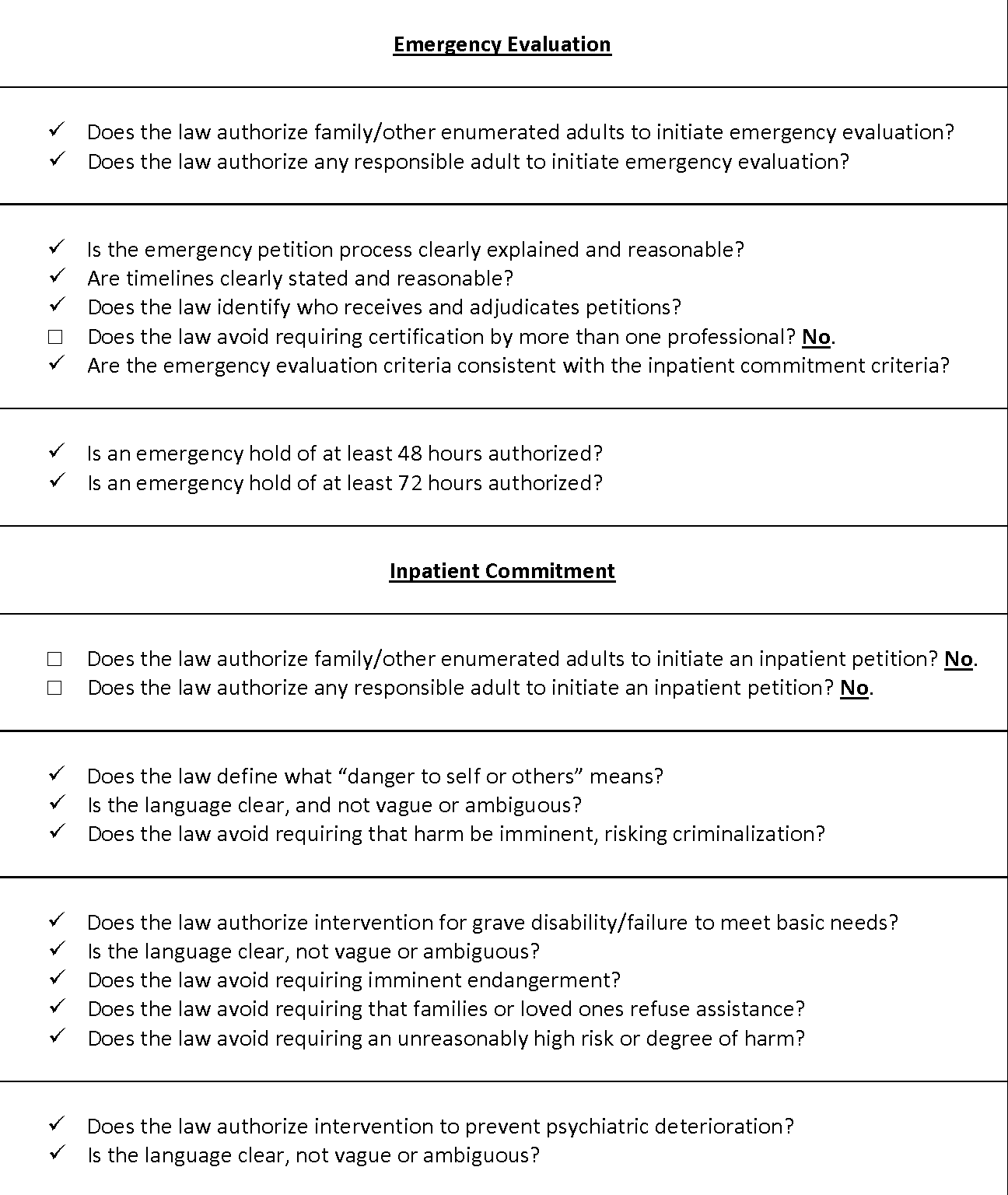
ALASKA STAT. § 47.30.730(a)(2). [The petition must] allege that the evaluation staff has considered but has not found that there are any less restrictive alternatives available that would adequately protect the respondent or others; or, if a less restrictive involuntary form of treatment is sought, specify the treatment and the basis for supporting it; ALASKA STAT. § 47.30.735(d). If the court finds that there is a viable less restrictive alternative available and that the respondent has been advised of and refused voluntary treatment through the alternative, the court may order the less restrictive alternative treatment for not more than 30 days if the program accepts the respondent. ALASKA STAT. § 47.30.755(b). If the court finds that there is a viable less restrictive alternative [to inpatient commitment] available [to a person who meets the inpatient commitment criteria] and that the respondent has been advised of and refused voluntary treatment through the alternative, the court may order the less restrictive alternative treatment … if the program accepts the respondent. ALASKA STAT. § 47.30.800. (a) A respondent ordered by the court under the provisions of AS 47.30.700 — 47.30.915 to receive involuntary outpatient treatment may be required to undergo inpatient treatment when the provider of outpatient care finds that (1) the respondent is mentally ill and is likely to cause serious harm to self or others or is still gravely disabled; (2) the respondent’s behavior since the hearing resulting in court-ordered treatment indicates that the respondent now needs inpatient treatment to protect self or others; (3) there is reason to believe that the respondent’s mental condition will improve as a result of inpatient treatment; and (4) there is an inpatient facility appropriate to the respondent’s need that will accept the respondent as a patient. Treatment for these respondents shall be available at state-operated hospitals at all times. (b) Upon making the findings specified in (a) of this section, the provisions of AS 47.30.795(c) relating to notice and AS 47.30.745 relating to hearings apply.
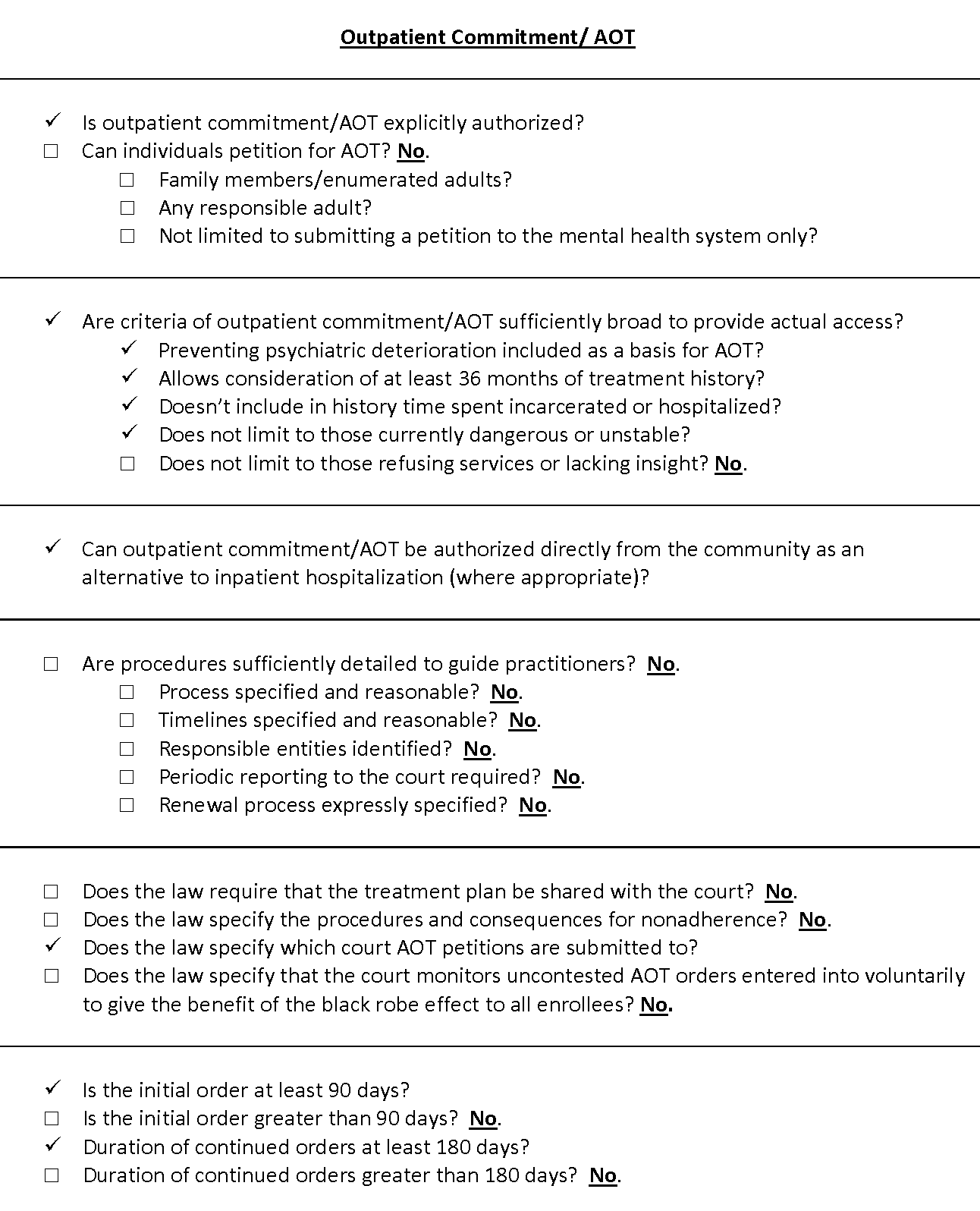
Recommended updates to treatment laws
- 1
Amend Alaska Stat. § 47.30.730(a) to authorize citizen right of petition for at least enumerated citizens, preferably any responsible adult, for inpatient and outpatient commitment
- 2
Amend Alaska Stat. § 47.30.915(11)(B) to provide practice guidance for psychiatric deterioration standard
- 3
Amend Alaska Stat. §§ 47.30.915(15), 47.30.735(d) to clarify that eligibility for outpatient commitment does not require current refusal, and may include foreseeable future refusal
- 4
Adopt procedural detail for outpatient commitment including provisions establishing timelines, periodic reporting to court, and court monitoring of voluntary settlement agreements
- 5
Amend Alaska Stat. § 47.30.735(d) to extend duration of outpatient order beyond 30 days
- 6
Amend Alaska Stat. §§ 47.30.740 and 47.30.755(b) to extend duration of continued outpatient order beyond 90 days